


Products
Extraction tower
An overview of commonly used continuous extraction towers includes the following types: The packed extraction tower is a widely used extraction device in petroleum refining, chemical industry, and environmental protection sectors. It features a simple structure, ease of installation, and manufacturing. The role of the packing inside the tower is to increase the contact area between the two materials, allowing for sufficient interaction. This enables the dispersed phase droplets to continuously break and coalesce, renewing the surface of the droplets, and also reduces the axial mixing of the continuous phase. In a typical packed extraction tower, the two phases flow in opposite directions relying on density differences, with relatively low relative velocity and low turbulence at the interface, which limits the further increase of mass transfer rates.
Classification:
Extraction and separation equipment
Keywords: new energy equipment, biological medicine equipment
INQUIRY
Product Description

Overview
Common types of continuous extraction towers include the following:
The packed extraction tower is a type of extraction equipment widely used in petroleum refining, chemical industry, and environmental protection, characterized by its simple structure and ease of installation and manufacturing. The role of the packing inside the tower is to increase the contact area between the two materials, allowing for full interaction, which can cause the dispersed phase droplets to continuously break and aggregate, renewing the surface of the droplets, and also reducing the axial mixing of the continuous phase. In a conventional packed extraction tower, the two phases flow in opposite directions relying on density, with a relatively low relative velocity and low turbulence at the interface, limiting the further increase of mass transfer rates. To prevent excessive coalescence of dispersed phase droplets and to increase turbulence within the tower, continuous or intermittent introduction of compressed air (pulsed mode) can be used to provide additional energy to the packed tower, increasing liquid turbulence. However, excessive turbulence can lead to emulsification of the two liquid phases, making separation difficult.
The baffle extraction tower is equipped with several layers of horizontal baffles, which change the flow direction of the two liquid phases to increase the interphase contact. The flow direction of the liquid in the tower is from one side of the baffle to the edge of the next layer's opening, and then flows towards the center, increasing the contact and mixing between the two phases. The inlet and outlet positions of the extractant and the mixed liquid being treated are determined based on their different densities, with the denser phase (heavy phase) entering from the top of the tower and being discharged from the bottom, while the less dense phase (light phase) enters from the bottom and is discharged from the top of the tower.
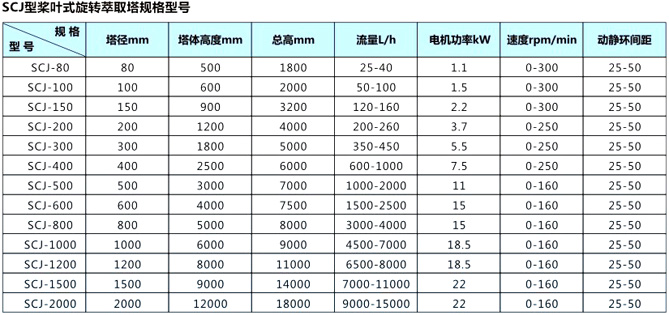
The paddle-type rotary extraction tower is also an extraction device that provides additional energy. The tower is divided into several sections by circular partitions, with paddles mounted on the rotating shafts of each section. During the extraction process, the agitation of the paddles increases the dispersion of the dispersed phase, promoting the renewal and expansion of the interphase contact surface area. The partitions help to some extent to suppress axial back-mixing, thus the efficiency of the paddle-type rotary extraction tower is relatively high.
The reciprocating sieve plate extraction tower has several layers of sieve plates fixed at certain intervals on a central axis, driven by a transmission mechanism at the top of the tower to perform reciprocating motion. The efficiency of the reciprocating sieve plate extraction tower is closely related to the reciprocating frequency of the tower plates. When the amplitude is constant, the efficiency increases with frequency, provided that emulsification and liquid flooding do not occur.
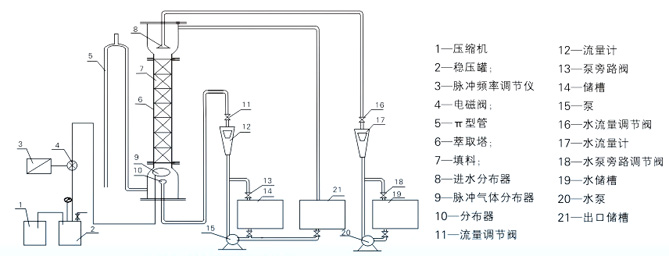
Structure and Characteristics
1. The extraction tower designed and manufactured by our company can provide good two-phase mixing conditions. The tower is equipped with nozzles, sieve plates, or mechanical stirring devices.
2. There are sufficient separation sections at the top and bottom of the tower to ensure good stratification of the two phases.
3. The body of the extraction tower and its internal components and pipelines are made of 304 or 316L stainless steel.
4. This extraction device is easy to clean and suitable for organic mixtures with high viscosity.
Next Page
Next Page
Related Products
ONLINE MESSAGE
* Note: Please be sure to fill in the information accurately and keep the communication unblocked. We will get in touch with you as soon as possible.
No.7, Tianhe Road, Yuhang Economic Development Zone, Hangzhou

All rights reserved© Zhejiang shuang zi Intelligent Equipment Co., Ltd. |SEO Tags | Business License